
Terrace with a View to Ancient Rome, Italy
I am standing on a terrace above Piazza Venezia, and the view before me resembles a postcard. In the distance rises the Colosseum; in the middle ground stretches the Roman Forum; and in the foreground stand the twin domes of two Baroque churches framing the statue of St Peter atop Trajan's Column, erected to commemorate the emperor’s victory in the Dacian Wars (in present-day Romania).

Trajan's Column and the Vittorio Emanuele Monument, Piazza Venezia, Rome.
Below, vehicles — tiny as toys — circle the piazza dominated by Palazzo Venezia. From its balcony Benito Mussolini once harangued the crowds; from here the building seems even more austere and square than usual. Opposite rises the gleaming white Vittorio Emanuele II Monument, dedicated to the king, which almost appears to exchange a knowing glance with the Pope in the Vatican, once the ruler of Rome.
Faced with such a panorama, a painter would reach for his brushes, a writer for his pen, and a musician might be inspired to compose a symphony. I am deeply attached to this place and return here often. Yet each visit feels like the first, for new emotions arise each time; and, with the help of a mental magic wand, I rearrange the scene before me, erasing and recomposing its elements into ever-changing visions.
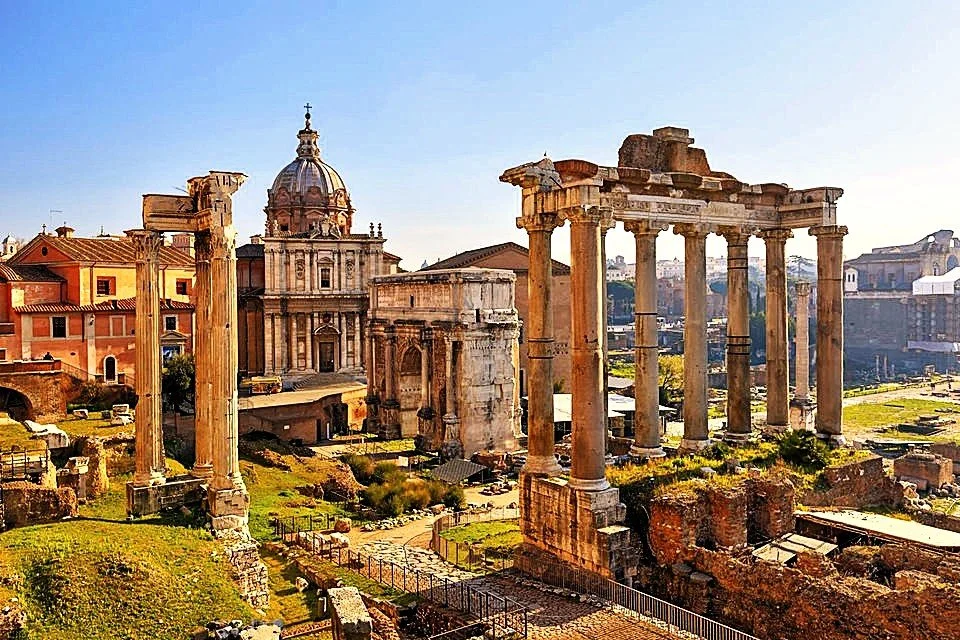
The ancient, sprawling Forum Romanum, Rome.
I travel back to antiquity and imagine Trajan's Column standing in the centre of a small courtyard between two libraries, one Greek and the other Latin. Romans, draped in togas, climb onto nearby roofs to examine the marble bas-reliefs spiralling along its surface. Today the column stands somewhat solitary, and at night it becomes a meeting place for the cats of Rome — those famous guardians of the ruins.
Another favourite haunt of theirs is Trajan's Market, the largest commercial complex of its age — what we might today call a shopping centre — housing some 150 shops. Nearby rose still grander buildings: exedras, temples adorned with statues, and basilicas embellished with precious marbles, forming the vast complex of the Imperial Forums stretching towards the Colosseum.

The historic House of the Knights of Rhodes and Malta (Casa dei Cavalieri di Rodi e di Malta), Rome.
Time moves on and the scenery changes. The landscape becomes bucolic: I am now in the Middle Ages. Flocks of sheep and herds of cattle graze before the Markets; gardens provide for everyday needs; and modest houses rise somewhat haphazardly atop the upper storeys of the semicircle that forms the Markets. One of these dwellings — perhaps more dignified than the others — still survives, and my eye lingers upon it. It resembles a painting. This fragment of medieval architecture, later enriched with a charming Renaissance loggia, belongs to the Knights of Malta. It was granted to them by the Pope during the Crusades, when they were known as the Knights Hospitaller.
A wave of tenderness overwhelms me as I contemplate this corner of Rome, which the vicissitudes of history have left at once resilient and fragile. The colossal marble monument to Victor Emmanuel II blocks the view of the Capitoline Hill, and I am not certain the Romans welcomed its construction in 1911.
So I prefer to erase it from my imaginary panorama and restore instead the garden of Mr Gorizio, who lived here in the Renaissance and was famous for the lively receptions he hosted, attended by the Roman intelligentsia. Michelangelo, Raphael, Pietro Bembo and Baldassare Castiglione all referred to those banquets as among the happiest moments of their lives.
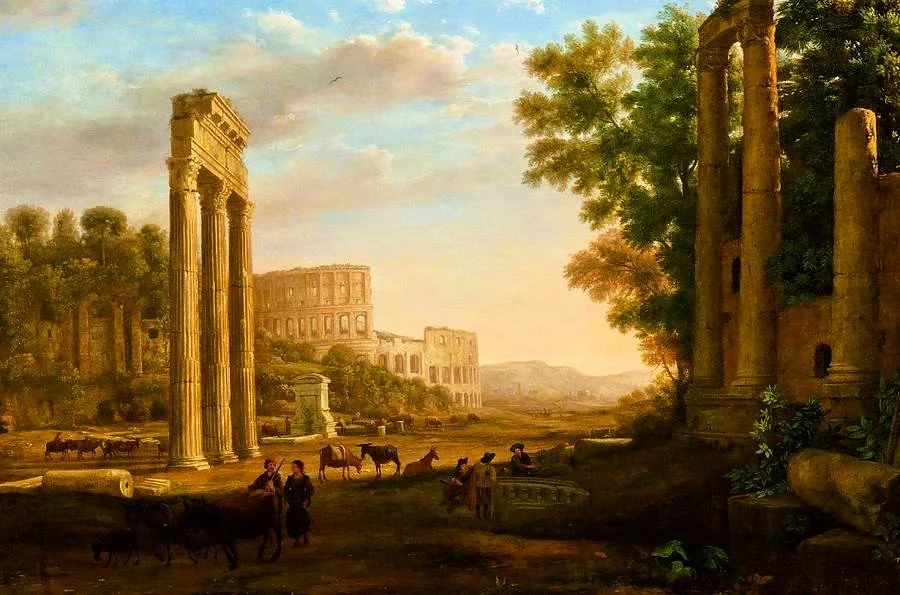
Capriccio with Ruins of the Roman Forum, by Claude Lorrain, 1635.
In the garden, on the slope of the Capitol overlooking the Markets, grew lemon trees beside sculpted nymphs and ancient sarcophagi, in keeping with Roman taste. There was also a shaded grotto with a fountain and an inscription inviting guests to drink, to wash, and to keep their mouths shut. I doubt, however, that such talkative company observed the last rule — unless they preferred to sit beneath the trees composing verses, as was customary in the Renaissance.
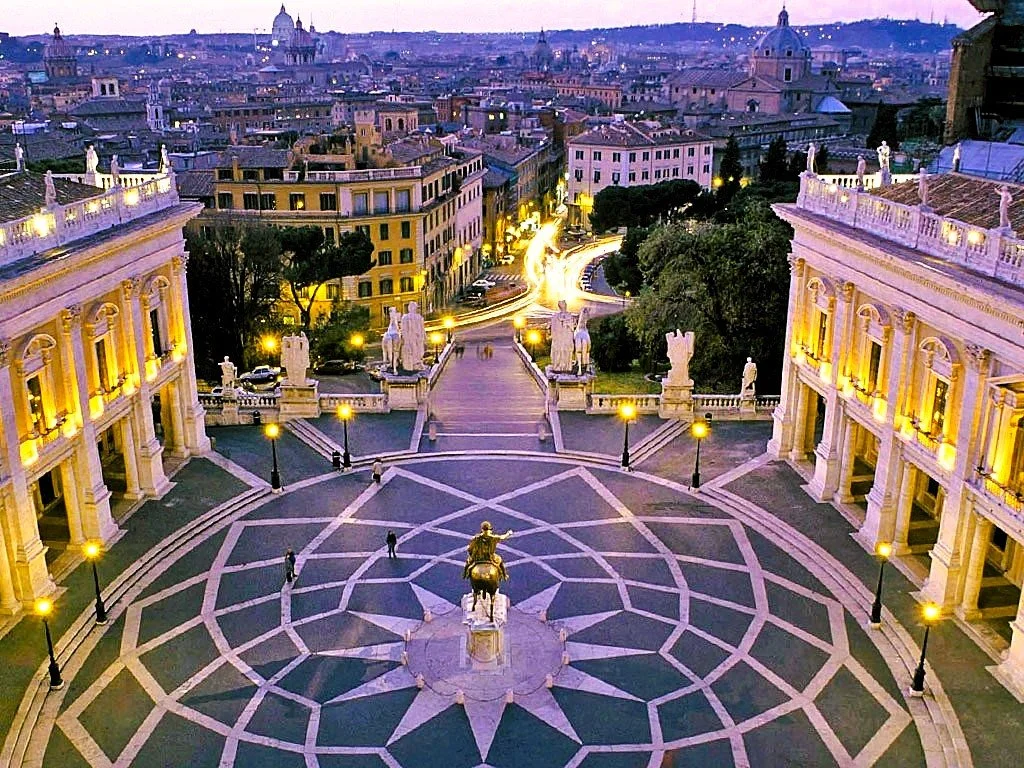
Site of the ancient Capitolium, the civic and religious centre, which became the Renaissance Campidoglio.
Over time the entire area I have described, stretching towards the Colosseum, became covered with houses. Visitors to Rome during the Grand Tour did not enjoy the clear panorama visible today. To create it, an entire neighbourhood had to be demolished on the orders of Benito Mussolini. While promoting the excavation and restoration of the ruins, he also opened the grand avenue known as Via dei Fori Imperiali, where large military parades still take place.

Saint Peter’s Basilica, bathed in the violet hues of sunset.
Pagan Rome, papal Rome, Mussolini’s Rome… The Eternal City, bathed in the violet light of sunset and contemplated from a terrace, awakens a singular emotion.
In my book Feeling Rome, I reflect on my long-cherished sojourn in Rome, a city that continues to inspire and enchant me
Relative Articles
Ancient Rome: Imperial grandeur and private worlds
A quiet journey through the private world of Rome’s first emperor, Augustus, where myth, politics and memory are carved into stone and fresco.
Read the Story
Hellenistic legacy: Power, beauty and exchange
From Athens to Alexandria and Rome, a world connected by ideas rather than borders.
Read the Story