
Nisyros, The Volcanic Island of the Aegean
Listening to the whispers of the Earth
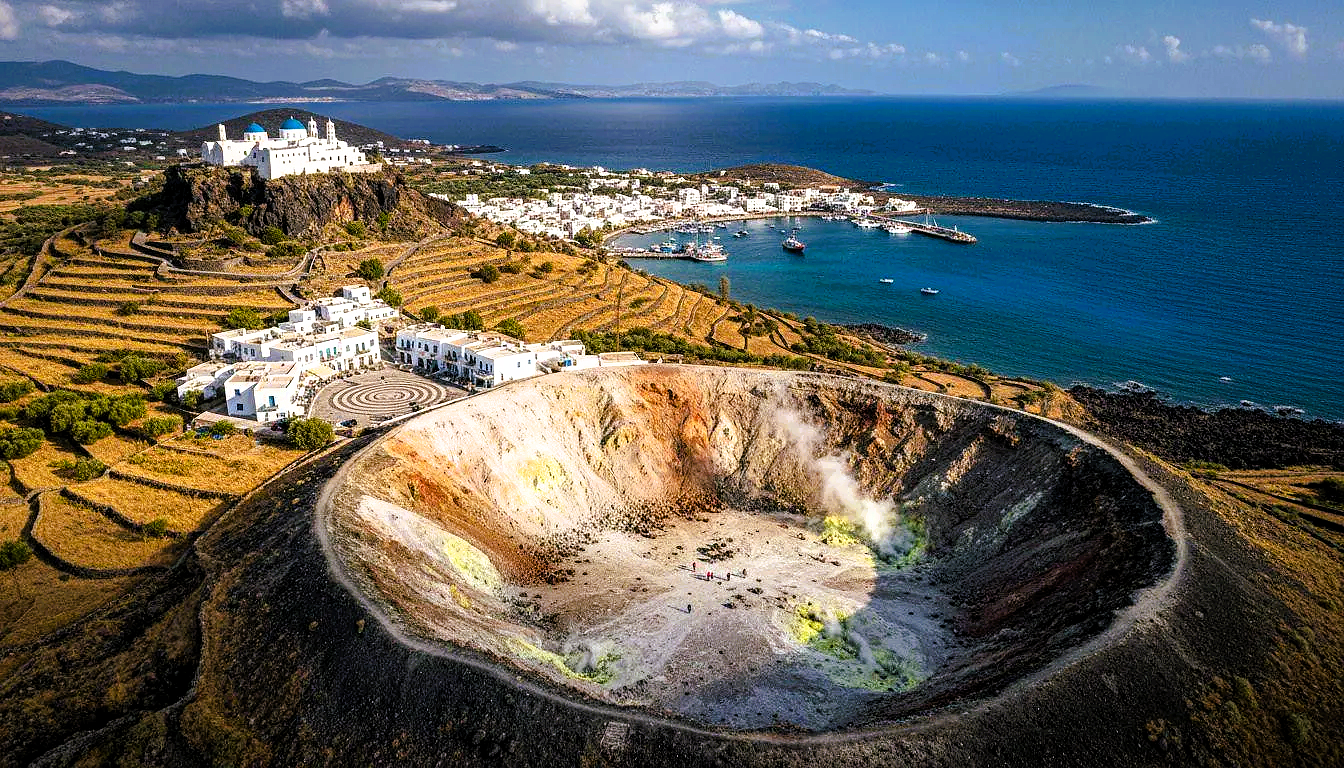
Nisyros from above: the island’s volcanic terrain, whitewashed port and hillside villages unfolding across the Aegean landscape.
Nisyros is an island of surprises. Lying in the Dodecanese, on the eastern edge of Greece, it is steeped in mythology and ancient history. Yet its greatest wonder lies elsewhere: its magnificent volcano, which began shaping this remarkable landscape some 110,000 years ago, carving out its almost perfectly circular form and the extraordinary caldera that visitors can still descend into and walk across today — one of the very few places on Earth where such an experience is possible.
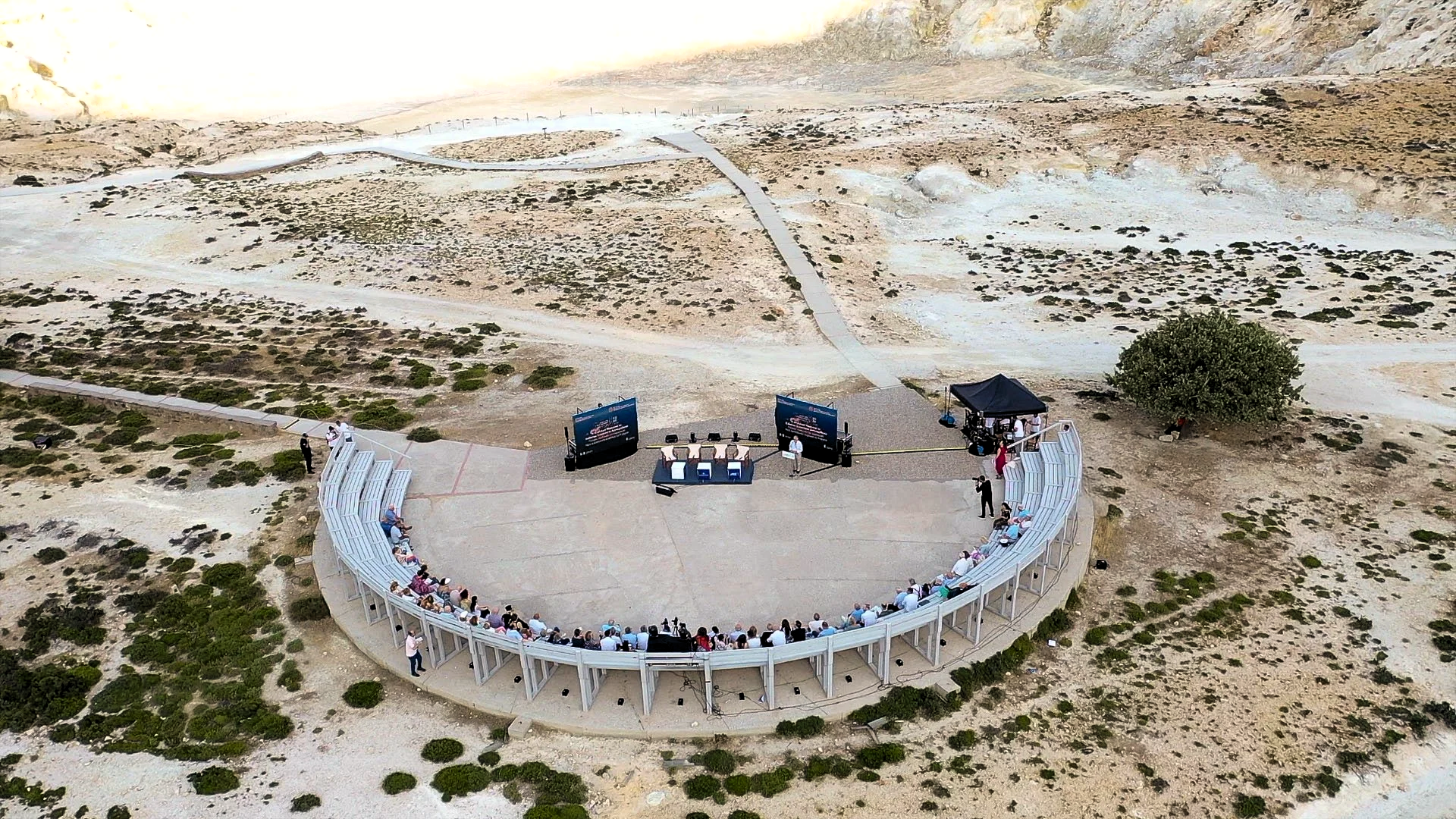
The “Nisyros Dialogues” at sunset, as Mr Panagiotis Mihalos, President of the Mihalos Foundation, welcomed guests against the golden hues of the caldera.
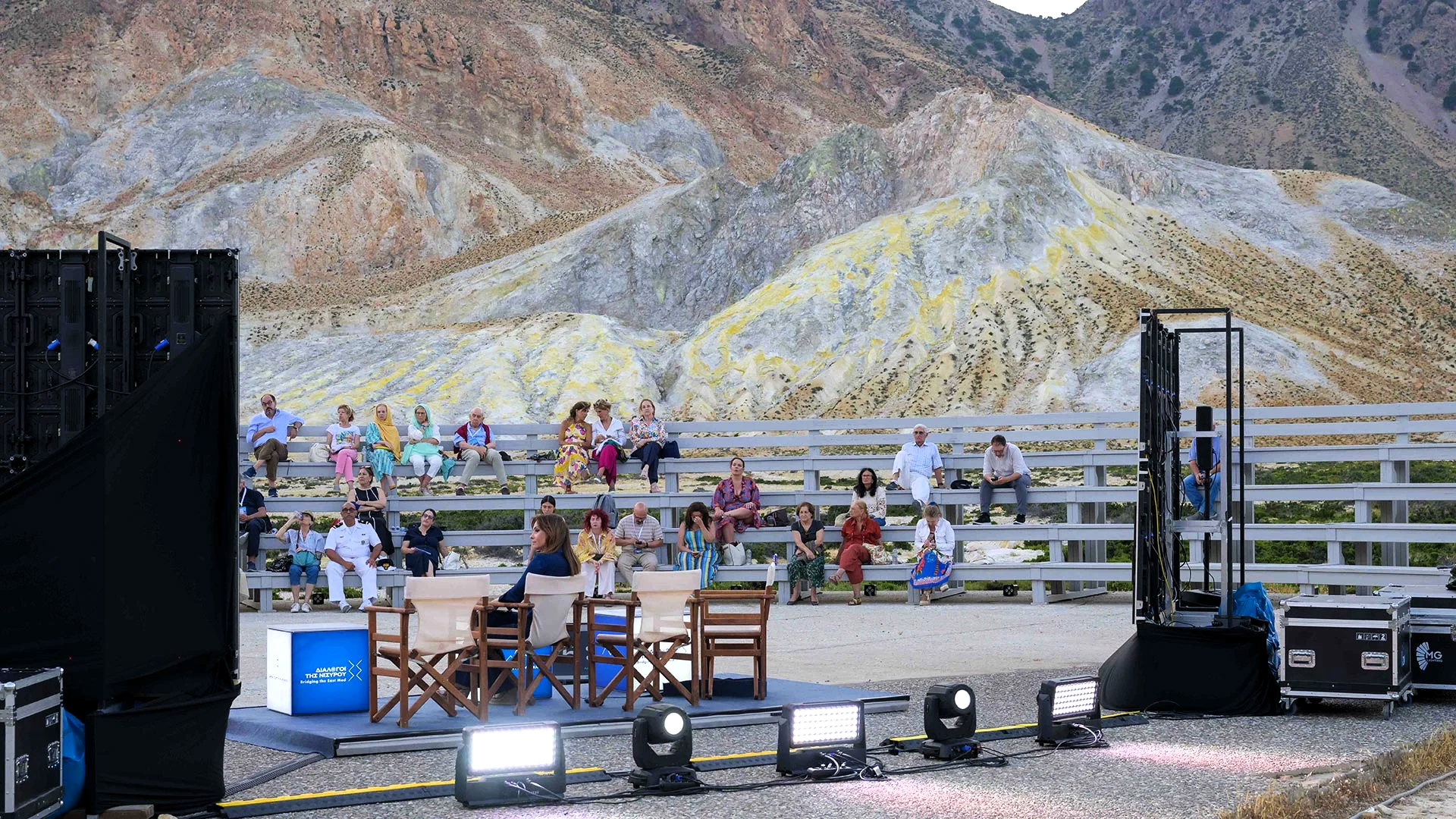
I had travelled to this otherworldly setting to attend the “Nisyros Dialogues - Bridging the EastMed” meeting, impeccably organised by the Mihalos Foundation on the very rim of the caldera. I cannot imagine a more fitting place in which to discuss the future of the Eastern Mediterranean. As the sun slipped into the Aegean, the walls of the crater glowed in molten shades of gold and copper, seemingly detached from the surrounding landscape, while the sky slowly surrendered to violet dusk. It was one of those rare moments when nature reminds us that beauty and power are born from the same source.
The traveller in me could not resist. To walk inside the crater of an active volcano? The answer was obvious.
Early the following morning, I returned to that lunar landscape, where I joined Dr Evi Nomikou, the renowned Greek volcanologist and Professor of Geological Oceanography. Invited by the “Nisyros Dialogues” as a guest speaker, she guided us through the hidden stories of the Earth.
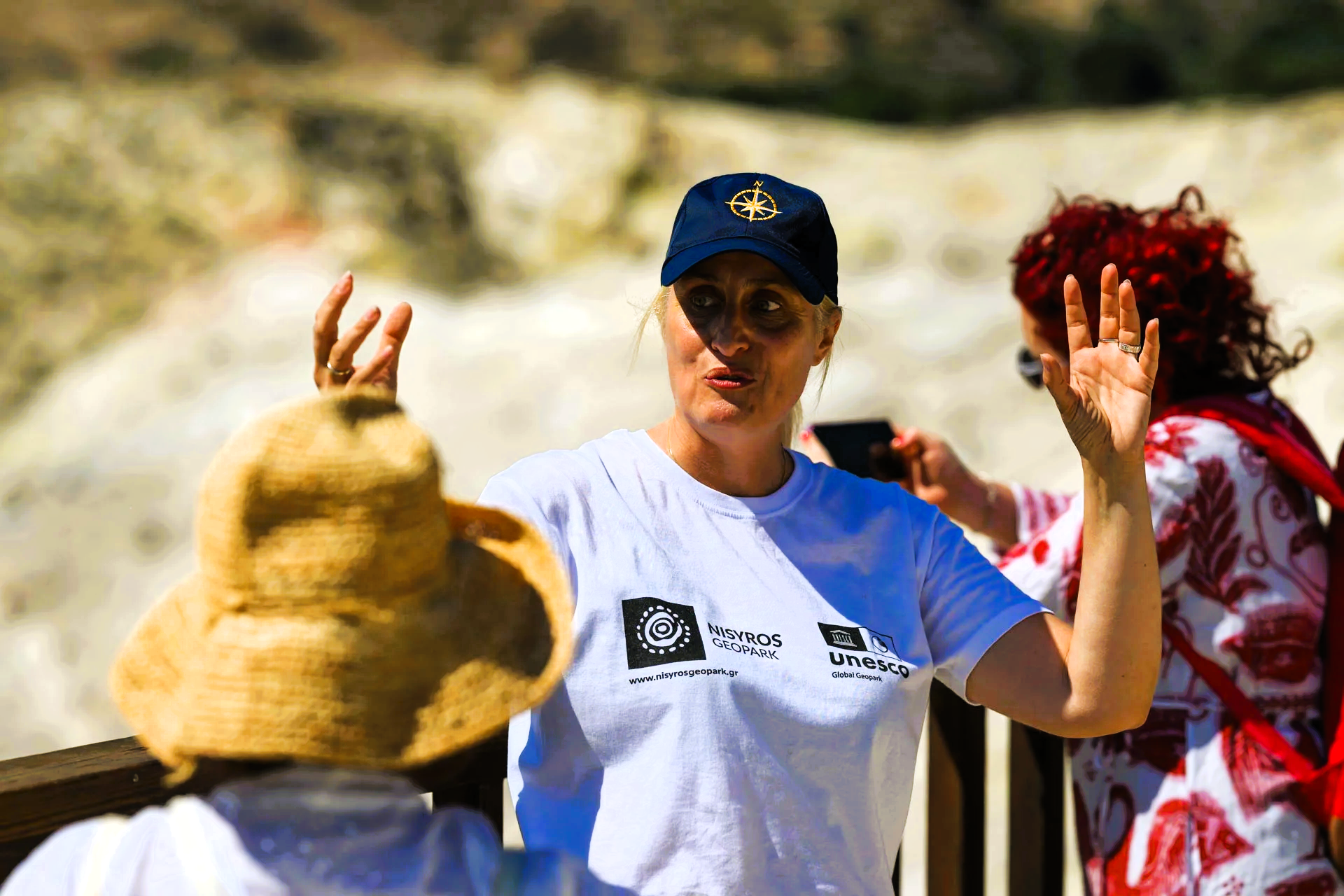
Dr Evi Nomikou unveiling the secrets of the Earth, as the author listens attentively.
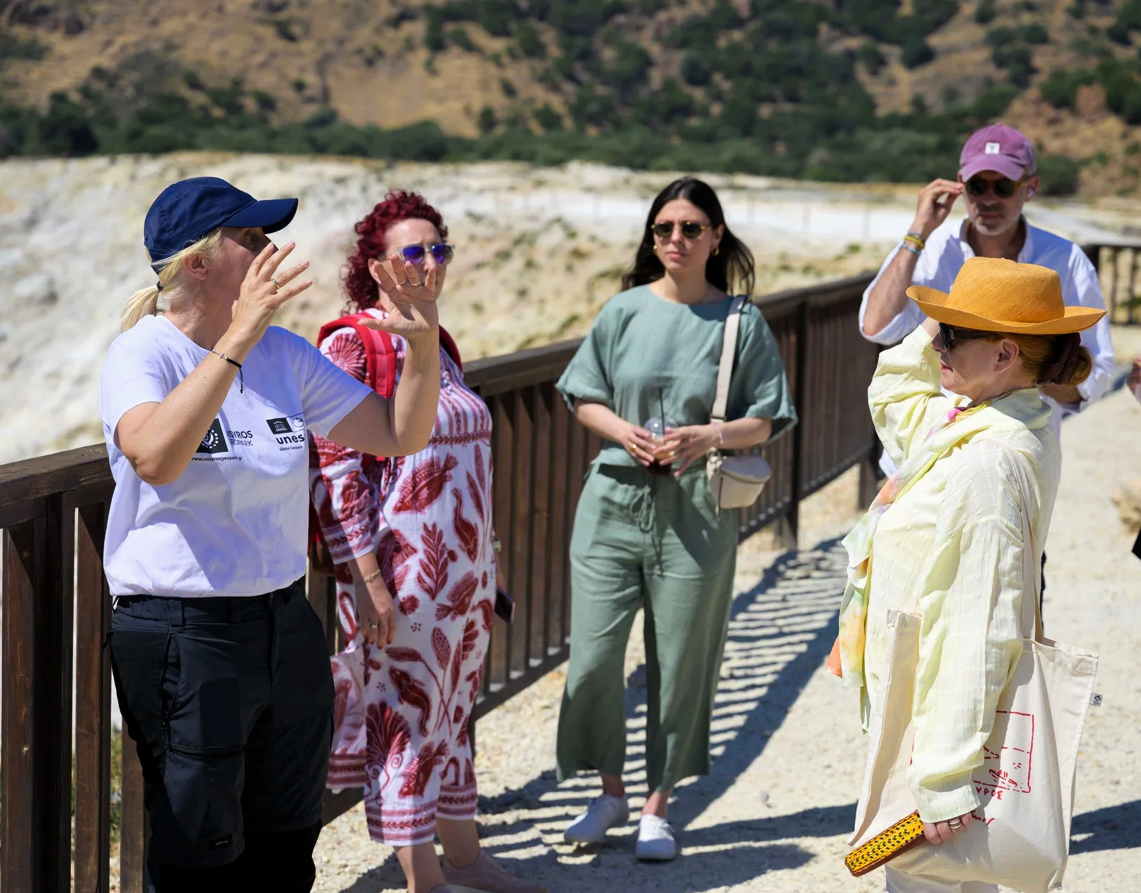
Born on Santorini, Greece's most famous volcanic island, Dr Nomikou speaks of Nisyros with unmistakable affection. It is not merely another field site or research project. To her, the island is a living organism that continues to breathe. "Here," she told us almost in a whisper, "the Earth has never stopped speaking."
From that moment, I saw the landscape differently.
Until then, I had admired an impressive crater. She taught us instead to notice the subtleties: the wisps of steam escaping through fissures in the ground; the unmistakable scent of sulphur, reminding us that powerful forces continue their work far beneath our feet; the palette of whites, ochres, yellows and greys spread across the rocks, as though nature itself had signed its masterpiece.
Nisyros is not a volcano that dazzles with spectacular eruptions or rivers of lava. Its power is quieter, almost contemplative. It invites you to slow down, to kneel, to touch the warm earth and feel the invisible energy rising from its depths. Rather than fear it, you find yourself respecting it.
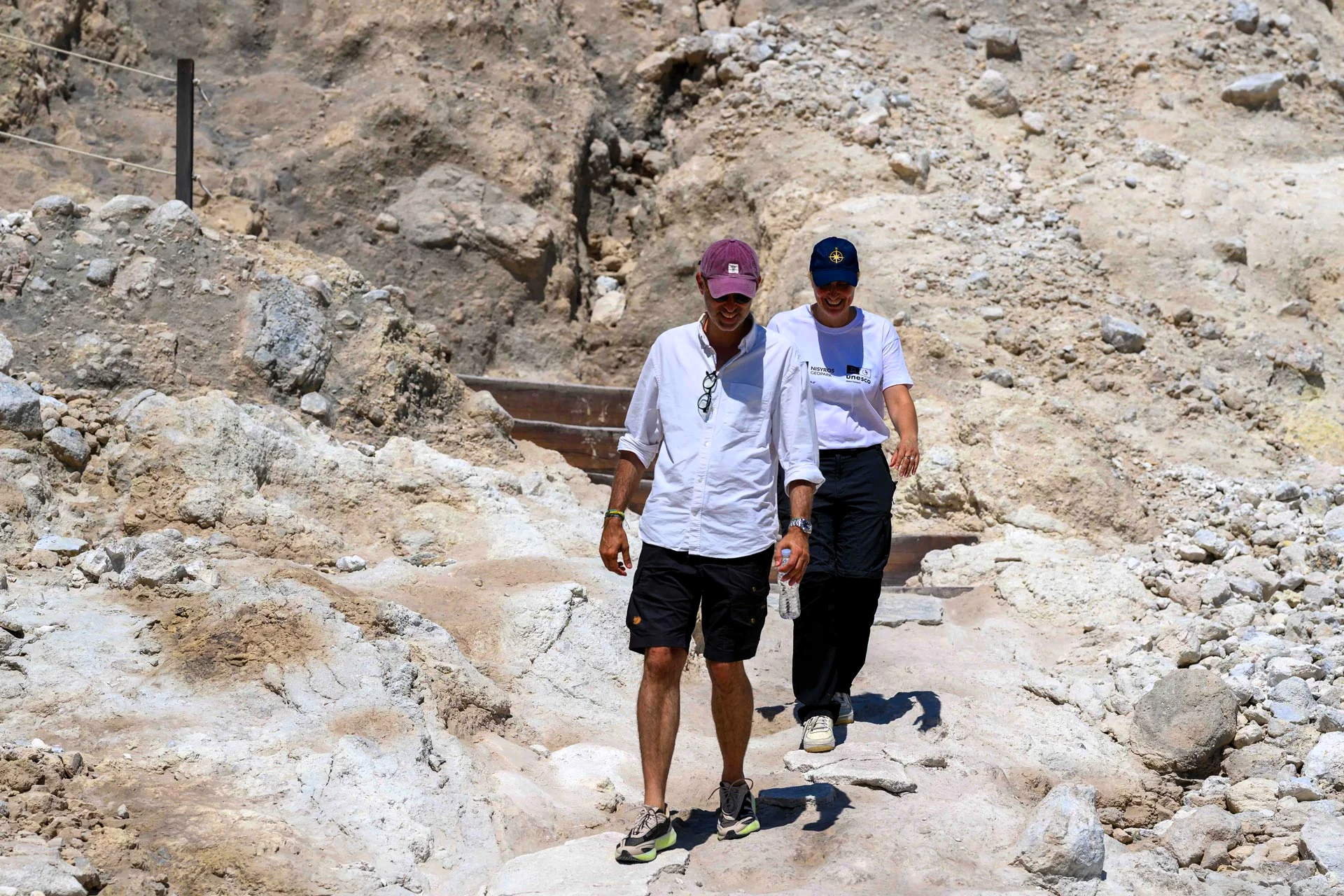
Dr Evi Nomikou leads our descent into the caldera, as we enter the heart of the volcano and feel the Earth’s ancient energy rising beneath our feet.
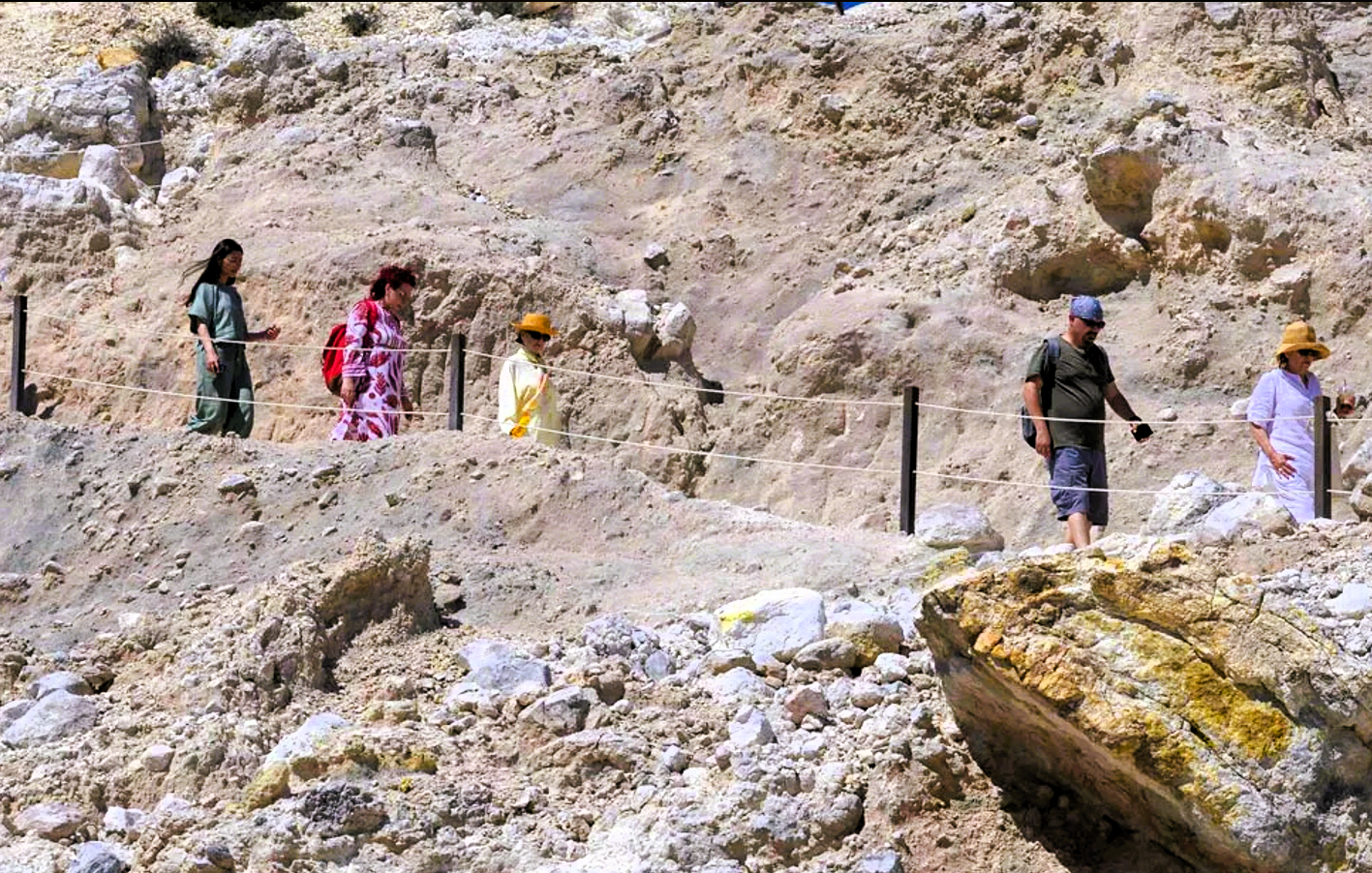
Dr Nomikou did not overwhelm us with scientific terminology or statistics. Instead, she told a story whose main character was time itself — a span of time almost impossible for the human mind to comprehend. Layer by layer, eruption after eruption, the island took shape. The ground collapsed to form the caldera, while deep below the surface the volcano remains very much alive.
"The Earth," she said at one point, "keeps its own rhythm. It is never in a hurry."
That sentence stayed with me far longer than any geological explanation.
It is no coincidence that Dr Nomikou has devoted her career to studying Greece's volcanoes. Through countless research expeditions, international collaborations and years of fieldwork, she has helped map and deepen our understanding of the South Aegean volcanic arc. Yet what impressed me most was not simply the breadth of her knowledge, but her generosity in sharing it. She brought science out of the laboratory and into the landscape itself, allowing us to experience it beneath our own feet.
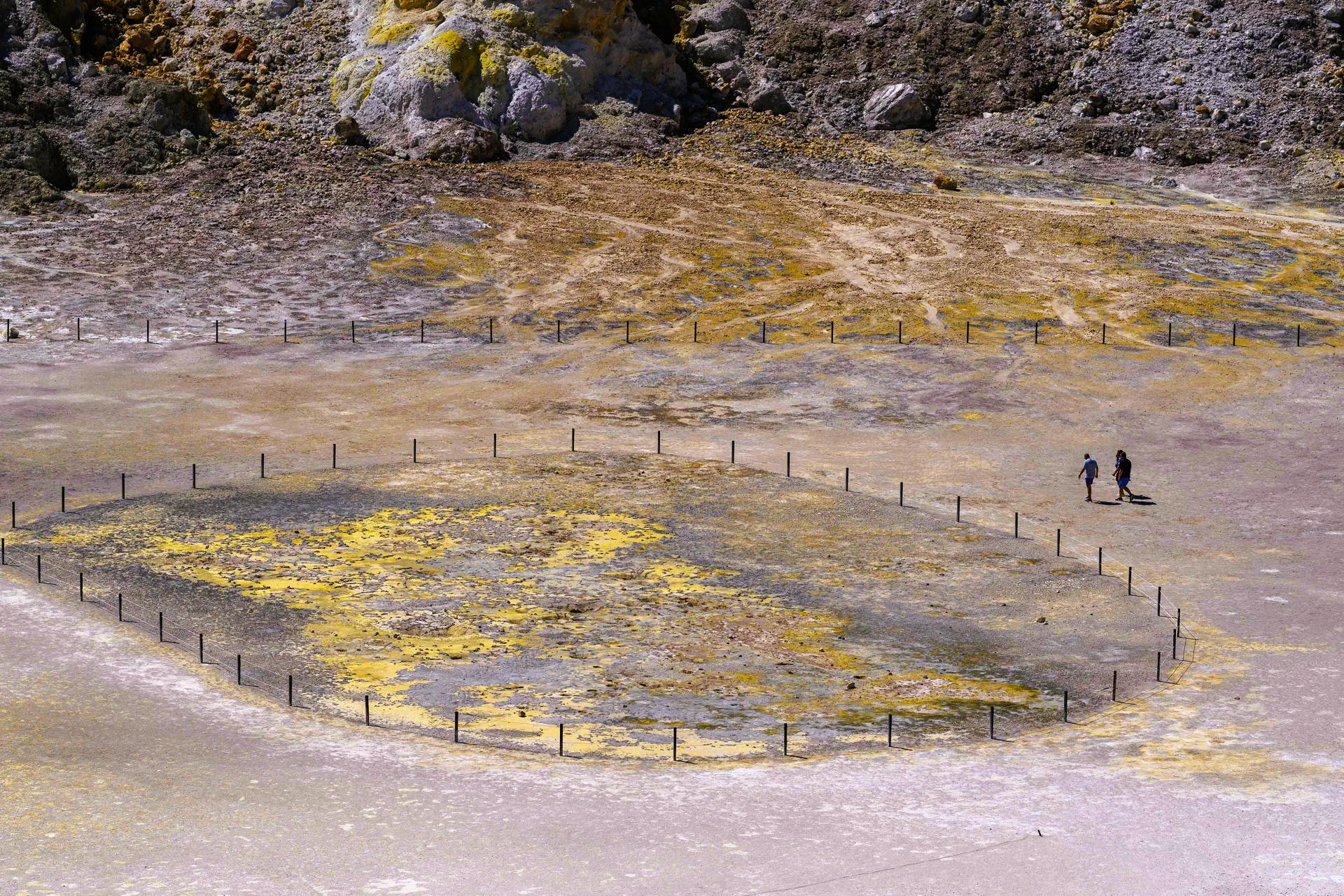
Inside the otherworldly crater, a lunar landscape of rising vapours and ancient whispers — a place where the Earth seemed to speak.
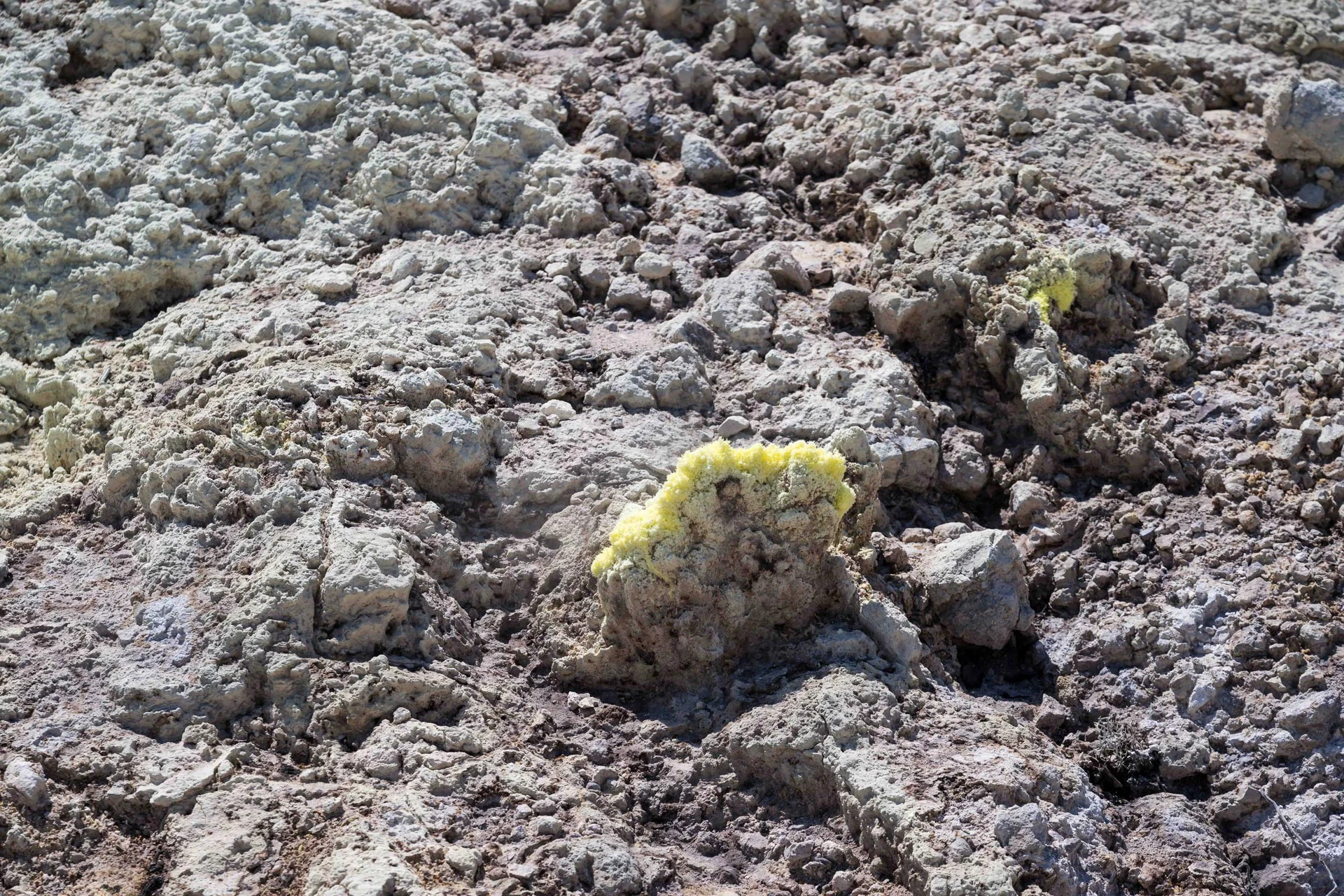
Thanks in no small part to her work, Nisyros has gained international recognition as a place of exceptional geological significance. Today, the island is home to the Nisyros Geopark, a natural laboratory where scientists from across the globe study the continuing evolution of this remarkable volcanic region. And yet, for all its international acclaim, Nisyros has lost none of its quiet authenticity.
Walking across the crater, I felt each step carrying me further away from ordinary time. The silence was never complete. It was interrupted by the volcano's quiet breathing, by the faint sighs rising from deep within the Earth. I looked back towards the rim of the caldera, where only the previous evening we had debated the pressing issues of our modern world. Now, all that remained was geological eternity. Human concerns suddenly seemed fleeting beside the memory of the planet itself.
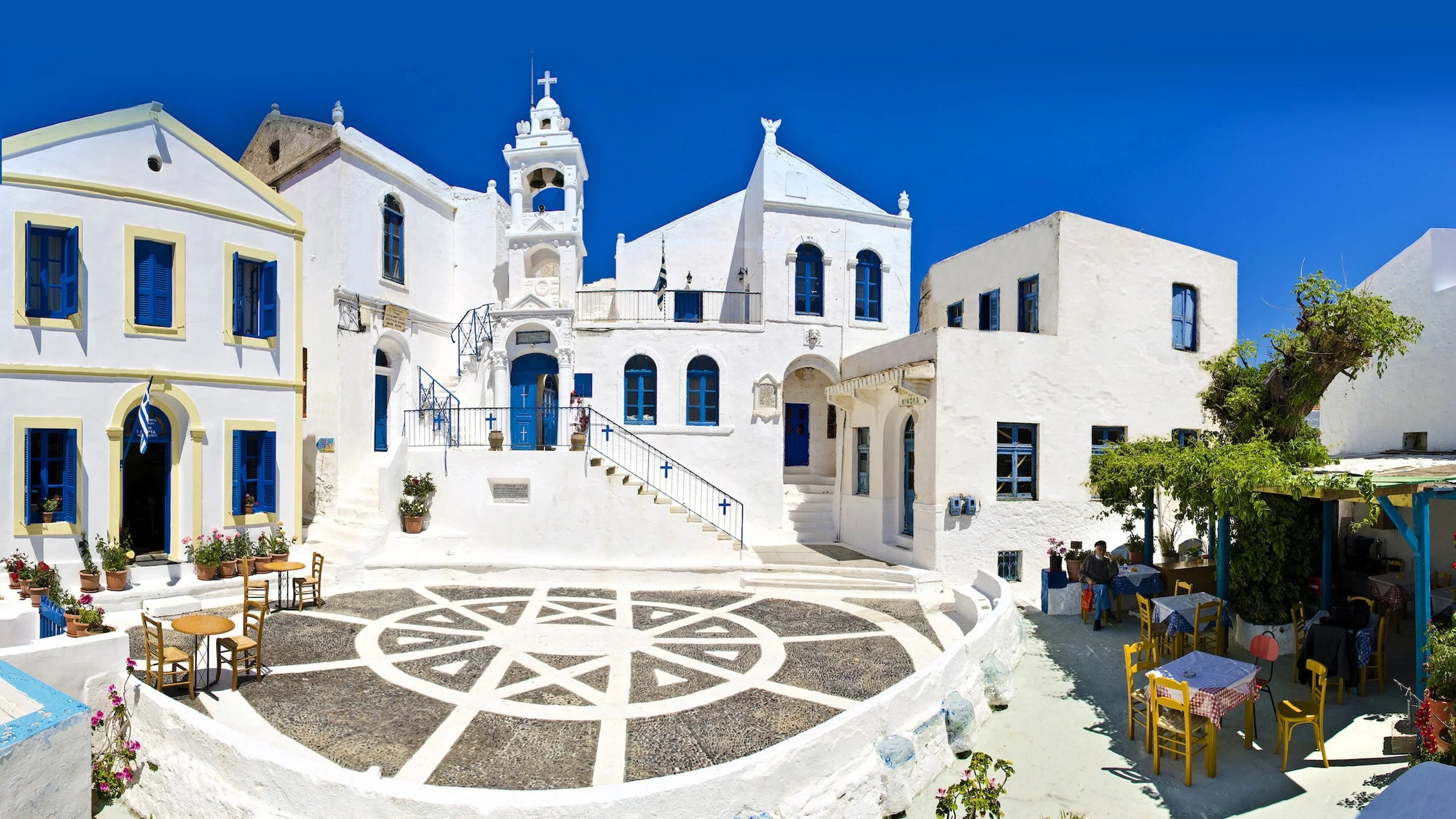
The enchanting village of Nikia, perched on the edge of the caldera, where we gathered for a memorable farewell dinner hosted by the “Nisyros Dialogues”.
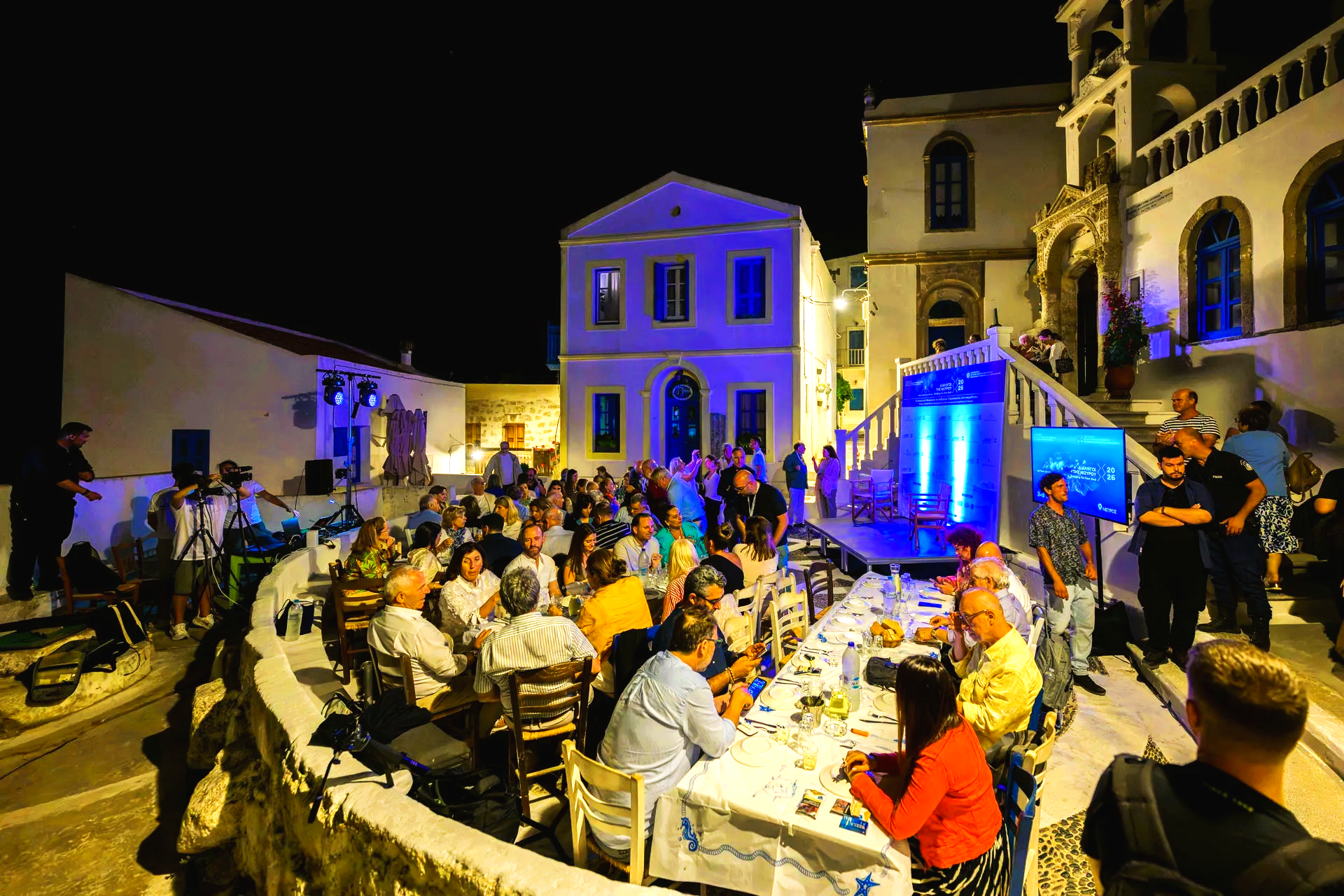
I left Nisyros carrying far more than photographs. I left having encountered a place that inspires not only awe, but humility. A place that reminds us that our planet is a living organism, and that we are merely passing visitors in its immeasurably long story.
Perhaps that is Nisyros' greatest gift. It does not simply invite you to see a volcano.
It invites you to listen to the Earth breathe.
Join me on a journey across the Greek islands, through the pages of my book GREECE, The Dance of the Seas
Related Articles
From the Earth's depths to the roof of the world — and landscapes carved by time, nature and wonder.
Bhutan: Tiger’s Nest Monastery and the Path to a Sacred Height
The climb to Tiger’s Nest unfolds through mountain trails, changing horizons and moments of quiet challenge before revealing one of Bhutan’s most extraordinary sanctuaries.
Read the Story
Petra: Jordan’s Rose-Red City
Hidden beyond the narrow Siq, Petra reveals how the Nabateans transformed sandstone cliffs into one of the world’s most extraordinary archaeological treasures.
Read the Story