
The pearl of the Italian Riviera, Portofino, Italy

A spectacular view of Portofino's charming harbour.
In Portofino, time has always seemed to grow gentle. Some places impress you; others remain with you long after you have left. This small harbour on the Italian Riviera belongs, for me, to the latter. Pliny the Elder once called it Portus Delphini, for the dolphins that moved through its waters. Whether Phoenicians, Greeks or Romans first settled here is uncertain. What endures, far more clearly than its origins, is its atmosphere.
I never stay long — usually a pause of two days on my way from Rome to the south of France — yet those days feel curiously complete. It is here that I understand, without effort, what Italians mean by il dolce far niente. I do very little. I walk. I sit. I look. There is no programme, no list of places to discover. Nothing is hidden; everything seems already offered.
The sea shifts in colour throughout the day, from dark green to cobalt, as it folds into small coves edged by steep cliffs. Pines and cypresses rise above villas that appear half concealed, half revealed. Along narrow paths scented with resin and salt, each bend opens onto another view — not dramatic, but quietly assured. The landscape does not try to astonish; it simply persists.
Around the harbour, the houses lean gently against one another, their green shutters set into walls washed with ochre, faded yellow and muted red. At first glance, everything seems entirely natural; only later do you notice the painted balconies, so skilfully rendered that they pass for real. In the late afternoon, fishermen pull their boats onto the shore, and the small rituals of the day draw to a close. Larger vessels remain at anchor in the still water.
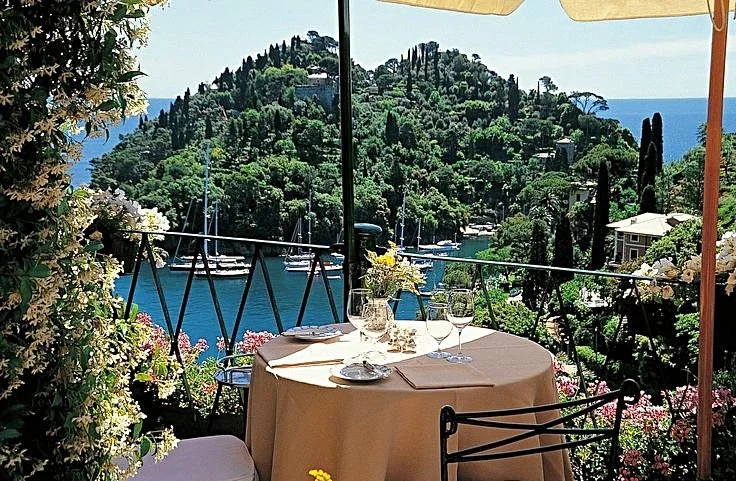
Castello Brown from the verandah of Hotel Splendido, Portofino.
On the western side of the bay, beneath the wooded rise crowned by Castello Brown, yachts lie moored in quiet rows. The castle takes its name from a British consul who once owned it, a reminder that this secluded place has long attracted those in search of retreat. In the 1950s, figures such as Rex Harrison found their way here, and Ava Gardner, Lauren Bacall and Humphrey Bogart arrived to film The Barefoot Contessa. Yet these stories feel like footnotes. The village does not depend on them.
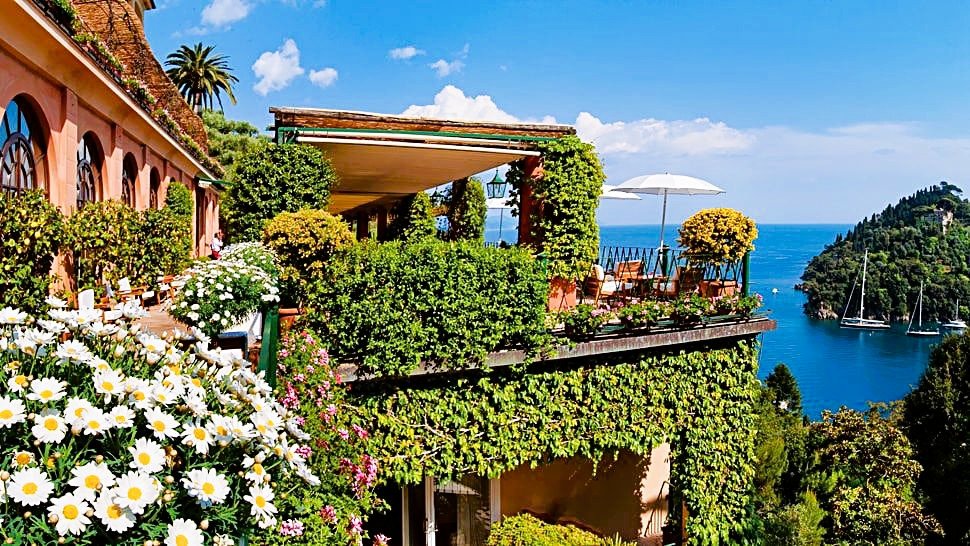
My retreat at Hotel Splendido, Portofino.
I often dine at Ristorante Puny, where dinner unfolds without ceremony, as though one had been expected all along. My room at Hotel Splendido looks out over the bay from a terrace suspended between garden and sea. The hotel’s terraced greenery — Mediterranean plants mixed with subtler exotics — seems less arranged than gently persuaded into place. A stepped path leads down to the harbour; by the time I reach the stone arch near the quay, I feel I have descended not only in height, but in pace.
At sunset, when the day visitors depart, the village settles into itself. Conversations soften. Glasses touch lightly. Once, I noticed two impeccably dressed men absorbed in a silent game of chess at a café table; another evening, a woman of unmistakable bearing walked past with her children, unremarked upon. In Portofino, even distinction seems to relax.
At night, from my terrace, I watch the lights gather around the harbour and the castle glow above it. I sometimes wonder whether memory has softened the edges of what I see. Yet each return confirms the same impression: nothing here is exaggerated. Nature has been generous, certainly, but the greater gift lies in the restraint with which it is lived. The beauty of this place is not theatrical, nor does it belong to fantasy. It is simply part of the day — and perhaps that is why it endures in mine.
Travel and writing have always existed together for me — each journey slowly becoming a story shaped by atmosphere, memory and place.
Related Articles
Florence: Tuscan Heritage and Cloistered Beauty
At Belmond Villa San Michele, Renaissance architecture, cypress-lined terraces and sweeping Florentine views evoke the quiet grandeur of Tuscany.
Read the Story
Venice: Hidden Gardens beside the Grand Canal
Beyond the bustle of Venice, Belmond Hotel Cipriani offers a world of lagoon serenity, private elegance and timeless Venetian charm.
Read the Story