
Elegance in Venice
Beyond the Myth of Venetian Melancholy
Venice reveals its elegance not as spectacle alone, but as a cultivated language of appearance, gesture and atmosphere, woven into the daily life of its inhabitants. In its streets and salons, colour and refinement coexist with an understated theatricality that has long defined the city’s identity.
On the canals and beneath the arcades, the Venetian sense of style persists with quiet confidence. Figures move through the city dressed with an instinctive attention to detail, their presence echoing a long tradition in which appearance was never incidental but an extension of civic culture. Even the smallest gestures seem shaped by an inherited awareness of form, as though elegance itself were embedded in the fabric of the city.

Giandomenico Tiepolo, The Promenade, 18th-century fresco, Ca’ Rezzonico, Venice.
This sensibility finds its most luminous expression in the artistic legacy of the eighteenth century. The canvases of Giovanni Battista Tiepolo capture a world suspended between grandeur and lightness, where ceilings open onto skies filled with allegory and movement. In the palazzi of the Grand Canal, frescoed salons still preserve the illusionistic brilliance of this age, when Venetian painting reached its final flowering before the decline of the Republic.
Within these interiors, the world of the Venetian aristocracy once unfolded: salons adorned with stucco, mirrors and gilded frames, where conversation and music animated rooms designed for display as much as for living. The Carnival season, in particular, transformed the city into a theatre of masks and invention, where identity itself became fluid beneath layers of costume and concealment. It was a celebration not of anonymity alone, but of transformation — a fleeting suspension of ordinary life in favour of aesthetic play.

Paolo Veronese, Votive Portrait of Doge Sebastiano Venier, Doge’s Palace, Venice.
Yet alongside this enduring elegance lies a persistent external perception of Venice as a city of melancholy. Writers and visitors have long projected onto it a sense of decline, a romanticised sadness attached to water, stone and fading grandeur. But such an interpretation often belongs more to the imagination of outsiders than to the lived reality of the city.
To those who observe Venice beyond cliché, the city does not appear as a place of sorrow, but as one that has absorbed its own history with composure. Its former political splendour belongs to the past, yet its cultural presence remains active and internationally resonant. Under the protection of contemporary heritage frameworks, Venice continues to play a vital role in European artistic and historical consciousness.
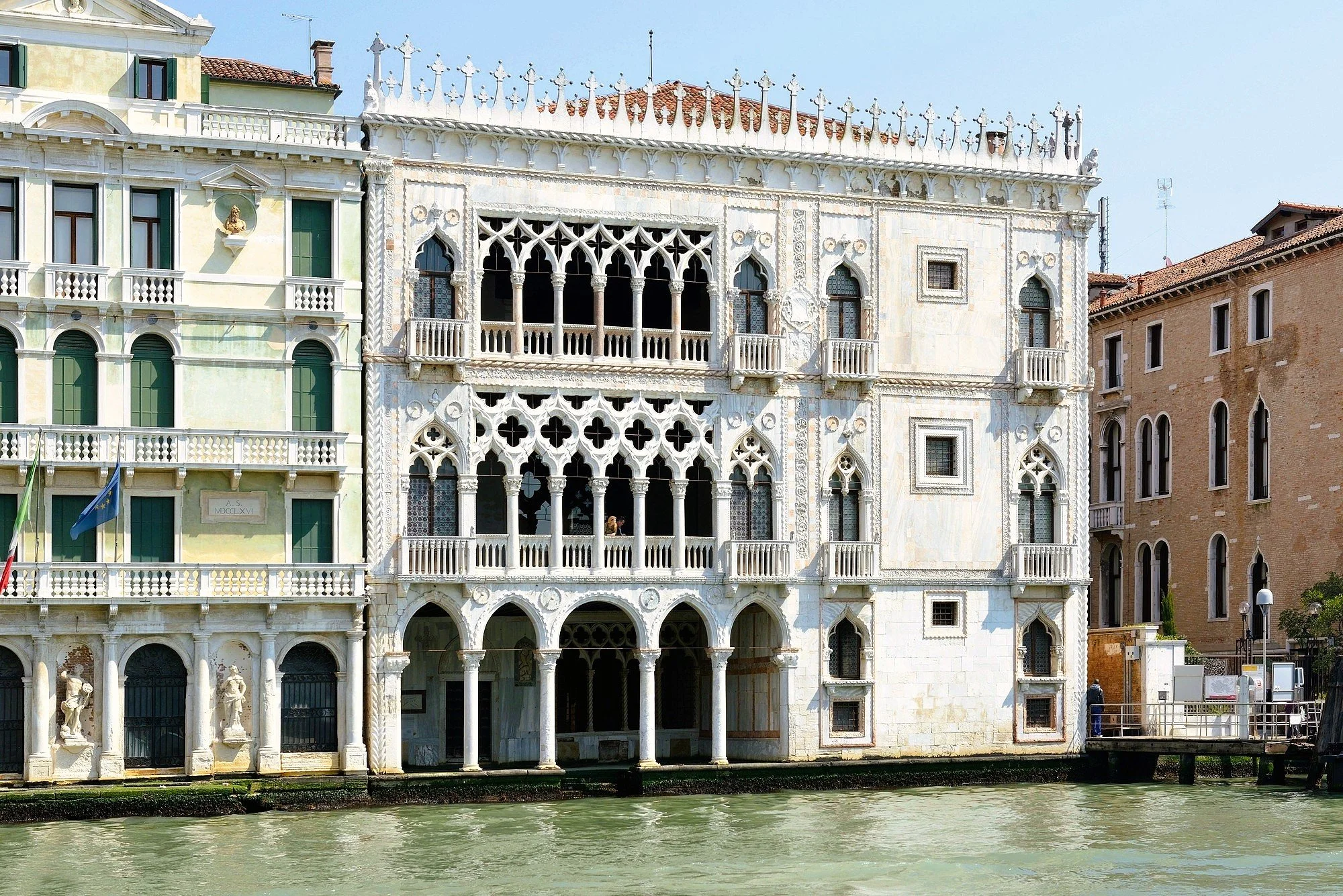
Ca’ d’Oro, — a jewel of Venetian Gothic elegance, reflected in the enduring beauty of the Grand Canal.
The notion of melancholy, therefore, dissolves under closer observation. Rather than a city defined by loss, Venice emerges as a place of continuity — where history is neither mourned nor forgotten, but quietly integrated into the rhythm of present life. Its beauty is not dependent on nostalgia, but on the ongoing dialogue between past and present, light and reflection, surface and depth.
In this sense, Venice is less a city of melancholy than a city of enduring elegance, where even decay, when perceived through the Venetian eye, becomes part of a larger aesthetic harmony.
Join me on a journey through the book: My Venice
Related Articles
Villa Valmarana ai Nani: Tiepolo Frescoes and the Artistic Splendour of Veneto
A journey into the Villa Valmarana ai Nani, where Giovanni Battista Tiepolo’s frescoes transform the walls into a world of myth, colour and eighteenth-century Venetian artistic brilliance.
Read the Story
Venice: A Dialogue Between Painting and Prose at the Atelier of a Contemporary Artist
An intimate reflection on the presentation of the book My Venice, where painting, writing and Venetian atmosphere converge in an inspired dialogue between artist and writer.
Read the Story