
Life at the Court of the Pharaohs
Perfume, Power, and Pleasure

Digital reconstruction of the Throne Room at Malqata Palace, on the west bank of the Nile, Luxor – Courtesy: Franck Monnier
In Egypt’s New Kingdom — an era often hailed as the civilisation’s radiant “Golden Age” — splendour suffused every corner of courtly life. With the nation’s population rising to nearly two million and prosperity flowing from the temples of Thebes to the fertile fields of the Nile, the pharaoh’s court became a stage upon which wealth, ritual, and refinement intertwined.
At the summit stood the pharaoh, whose household included a harem of secondary wives, many drawn from foreign courts to seal alliances. Yet only one woman held true supremacy: the Great Royal Spouse. Bearing both political authority and the kingdom’s highest religious role, she embodied prestige in its most exalted form.
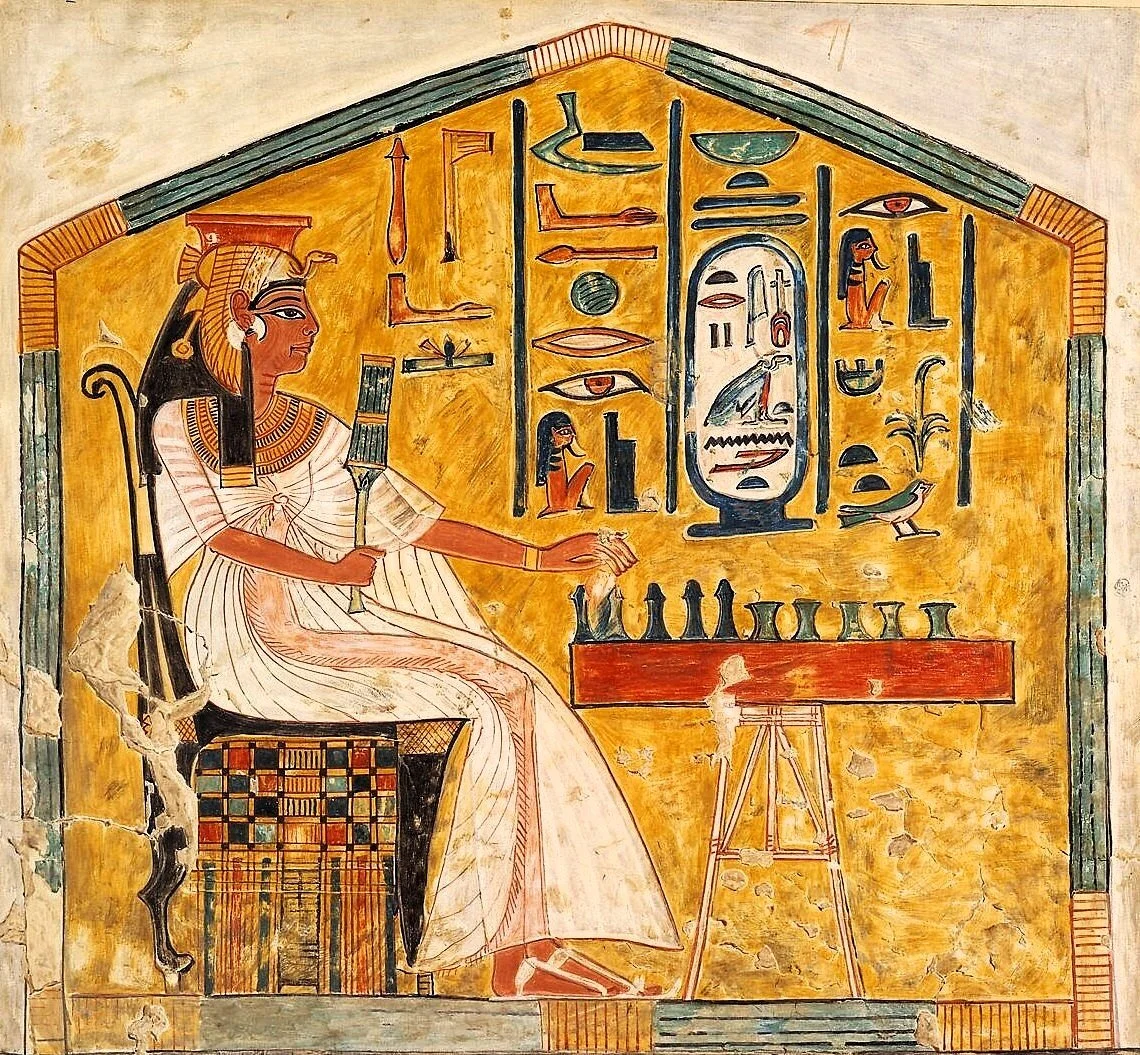
Nefertari, cherished Great Royal Wife of Ramses II – as depicted in the mural of her tomb in the Valley of the Queens, Luxor.
Within the palaces, luxury was an art. Gold shimmered on every surface, perfumes drifted like silk through the halls, and furniture carved with exquisite delicacy testified to a culture devoted to beauty.
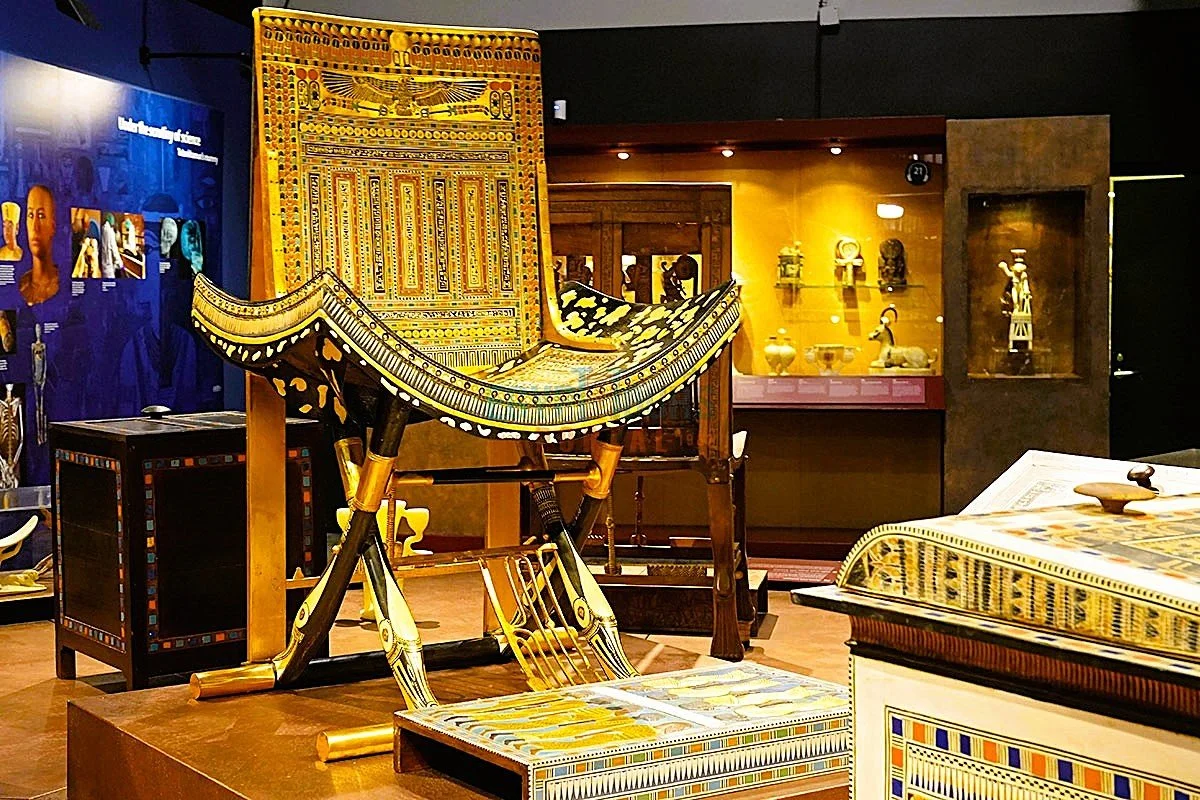
Ceremonial Chair of Pharaoh Tutankhamun, 18th Dynasty (c. 1332–1323 BCE) — Grand Egyptian Museum, Cairo.
Court ladies, pampered and poised, spent long hours perfecting their appearance. They arranged one another’s intricate coiffures, applied cosmetics before polished bronze mirrors, and anointed their skin with fragrant oils that softened the complexion and shielded it from the relentless sun. To the Egyptians, scent was not merely adornment but a moral virtue: to smell sweetly was to be pure.
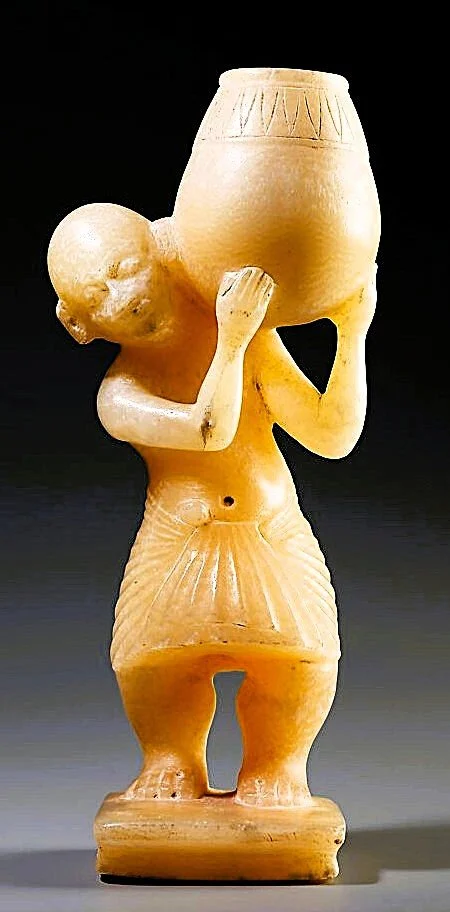
A cosmetic vessel in the form of a dwarf. 18th Dynasty – Metropolitan Museum of Art, New York.
Perfume accompanied them from dawn till dusk. Cones of aromatic ointment, placed atop the head, melted slowly through the warm nights, releasing a gentle, continuous fragrance. Myrrh, incense, and sweet herbs permeated their garments, while honeyed pastilles kept the breath delicately fresh.

Wigs were a vital element of Egyptian fashion, worn by both men and women– Banquet scene from the tomb of Nakht in the Valley of the Nobles, Theban Necropolis, Luxor.
Wigs, too, were indispensable. Egyptians shaved their heads for hygiene—warding off lice and shielding themselves from the sun—and turned to wigs crafted from human hair or plant fibres. These fell in lush curls or elaborate braids, often embellished with beads or slender ribbons of gold. A crescent-shaped headrest preserved the style during sleep. Men favoured shorter wigs, while boys shaved their heads, leaving a single side plait.
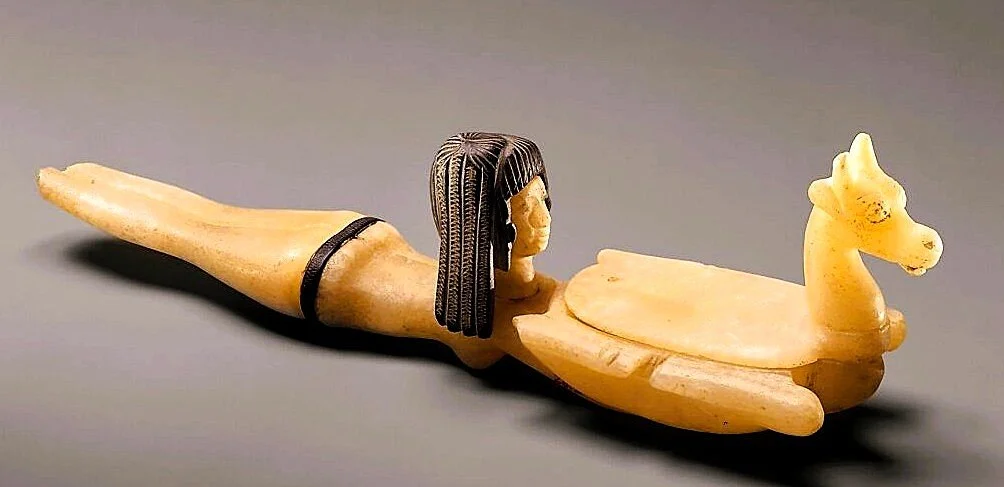
A cosmetic spoon shaped as a swimming woman, 18th Dynasty – Metropolitan Museum of Art, New York.
Cosmetics, treasured as both beauty and ritual, held a place of honour. Malachite and powdered copper shaded the eyelids in green and soft blue, while kohl, a mixture of galena and water, framed the eyes and shielded them from the fierce desert light. Red ochre tinted cheeks and lips, nails gleamed with deep crimson, and nourishing creams lent the skin a radiant lustre.

Banquet scene with female musicians and dancers, tomb mural – British Museum, London.
Yet beauty was only part of life’s tapestry. Evenings in the palace shimmered with music and revelry. Harps murmured, flutes lingered, and dancers moved with a grace that seemed almost divine. Servants glided between guests with trays of delicacies, pouring perfumed wine into slender turquoise vessels as laughter and conversation wove through the hall like another form of music.
Beyond the palace walls, leisure was equally cherished. Nobles drifted along the Nile in elegant boats, picnicked on its tranquil banks, and ventured on hunting excursions that blended relaxation with sport. Board games such as senet filled the quieter hours, offering both entertainment and a touch of intellectual intrigue.
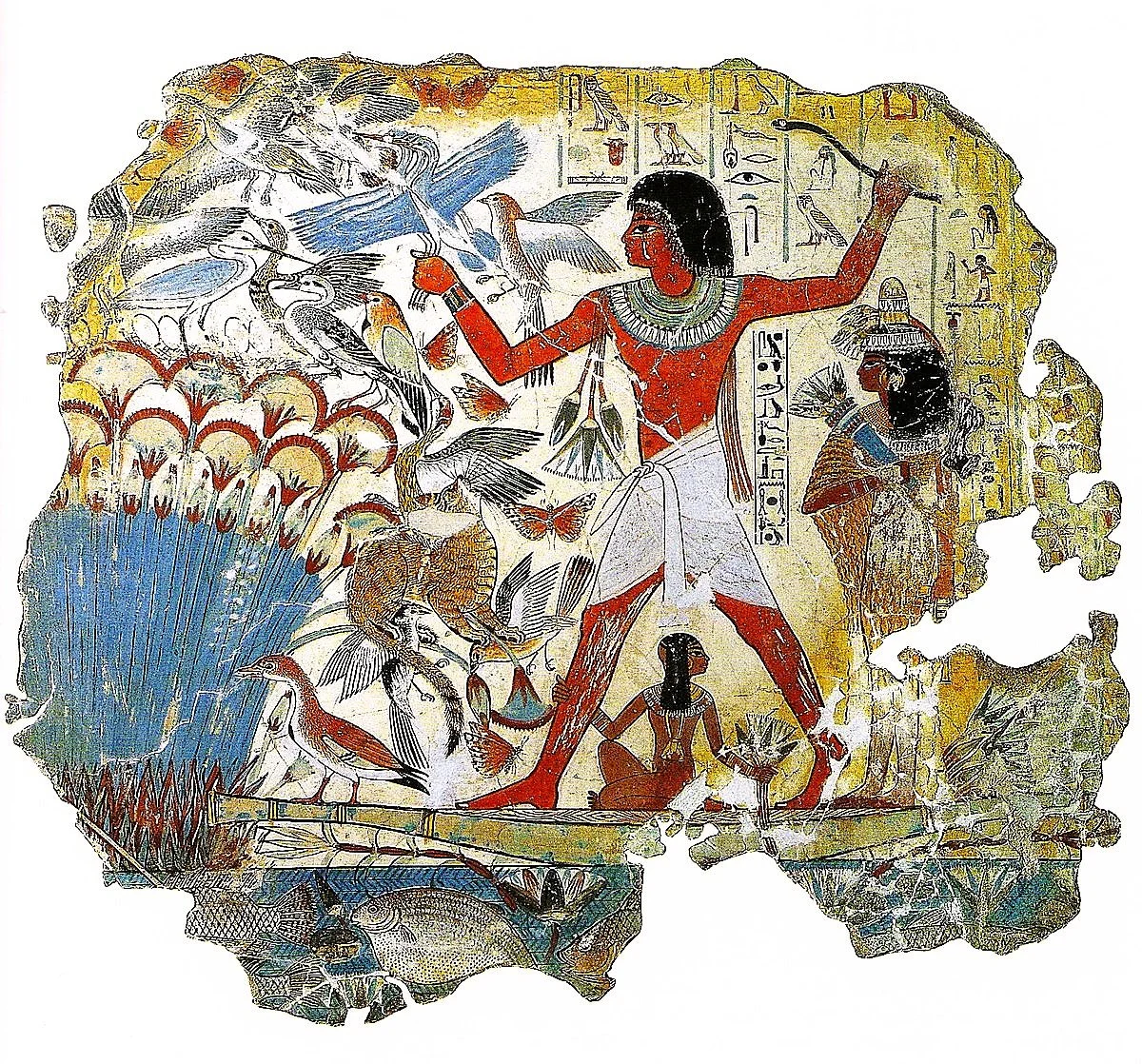
Hunting scene from the tomb of Nebamun in the Theban Necropolis. Luxor, Egypt. The mural is on display at the British Museum, London.
In every gesture, every fragrance, every shimmering note, the court of the New Kingdom cultivated a life of exquisite pleasure — a world in which refinement was not merely admired, but lived.
Τravel through the pages of my Books in English Books in Italian Books in Greek
The book EGYPT, A Journey to the Nile is published in Greek. It will soon be published in English.
Related Articles
Decoding Ancient Egyptian Hieroglyphs: Symbols of an Eternal Civilization
Sacred symbols carved into temples and tombs preserve the language, beliefs and extraordinary cultural legacy of Ancient Egypt, revealing a civilisation whose mysteries continue to captivate the modern world.
Read the Story
Abu Simbel from Above: A Flight over Egypt's Ancient Wonders
A breathtaking flight above the temples of Abu Simbel reveals the grandeur of Ramesses II's extraordinary legacy, framed by the vast Nubian desert and the tranquil waters of Lake Nasser.
Read the Story