
The Fork of the Byzantine Princess Venice, Italy
She would touch nothing with her hands. Only after the eunuchs had carefully divided her food into the smallest pieces would she, with a quiet sense of ritual, raise a morsel to her lips using a small golden fork with only two tines.
It was at a banquet in the Doge’s Palace in Venice that Maria Argyre was observed in this manner, newly arrived as a bride, her marriage to the Doge’s son having been solemnised in Constantinople in the year 1004.
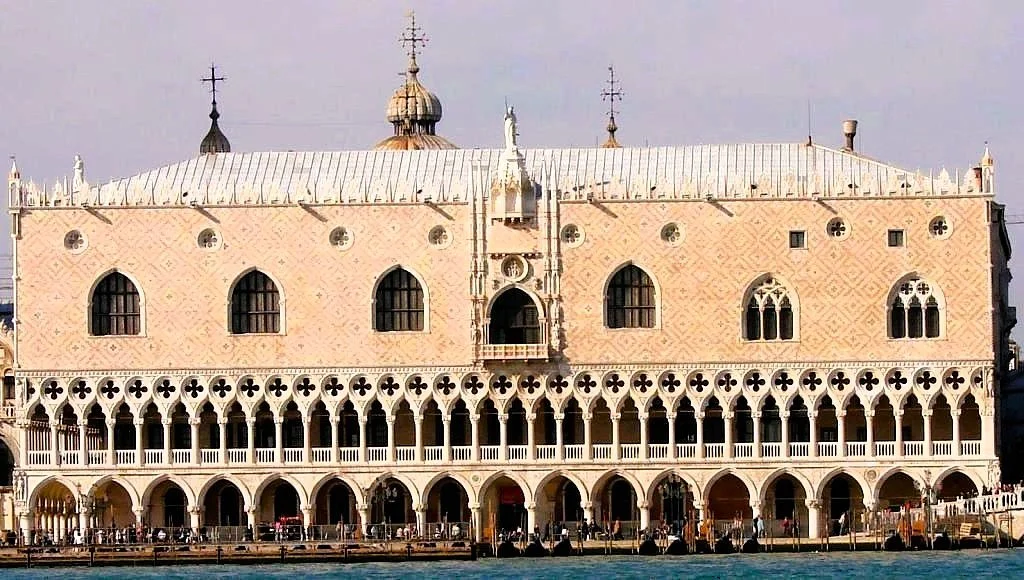
The Doge’s Palace, Venice, built in the 14th century, exemplifying the splendour of Venetian Gothic architecture.
The Byzantine princess, delicately eating with her golden fork, could not have known that this seemingly private gesture would, in time, alter Western habits of dining and introduce a new idea of refinement into European table culture.
In this way, the fork entered the world of the West.
Maria had been formed within the rarefied world of the Byzantine court — a sphere of enclosed splendour governed by ceremony, eunuchs, and women, far removed from the turbulence and political urgency of the imperial city beyond its walls. Within that world, life unfolded in measured harmony: gardens in perpetual bloom, fountains murmuring in shaded courtyards, and the steady cultivation of an almost liturgical sense of order.
When she arrived in Venice, her habits were regarded with a mixture of curiosity and unease. The Venetians, practical and maritime in temperament, perceived her refinement as excessive, even affected. She declined, for instance, to wash in the public baths customary to the city, preferring instead to have her attendants collect rainwater for her personal use. Her chambers, it was said, were scented with wild thyme, as though she sought to recreate within Venice something of the aromatic stillness of her eastern homeland.

Byzantine Princesses, Dolce & Gabbana, Fall 2013, Italy — regal elegance inspired by imperial splendour.
Yet what appeared to the Venetians as foreign delicacy would, in time, reveal itself as a quiet cultural transformation. Through such exchanges — half diplomatic, half intimate — Venice became a threshold between worlds: East and West, austerity and ornament, necessity and refinement.
The fork, so modest in appearance, thus carries within it a longer history of encounter. In the hands of a Byzantine princess at a Venetian banquet, it marks not only a change in manners, but the beginning of a subtle reorientation of European sensibility — where eating itself begins to move from necessity towards ceremony, and from sustenance towards art.
Where travel meets culture and storytelling. Discover the world of the book: My Venice
Related Articles
Venice and the Ottoman Harem: The Story of Nûr Bânû, the Venetian Sultana.
An essay on the extraordinary life of Nûr Bânû Sultan, tracing Venetian women in the Ottoman Empire and the cultural exchanges between Venice and the Eastern Mediterranean world.
Read the Story
Venice and the Colours of the Orient: From Byzantium to the Islamic World in the Art of the Serenissima.
An evocative cultural essay tracing the flow of Byzantine influence and Islamic artistic exchange into Venice, revealing how trade, colour and ornament shaped the visual imagination of the Serenissima.
Read the Story