
Strolling around Salvador, Bahia, Brazil
Salvador unfurls like a dream — forests of palms swaying above dunes of white sand that reach all the way to the airport. People smile without hurry, untouched by the pressures of modern life. The Baianas, plump and serene, stand in their lacy white dresses and colourful turbans, necklaces of gaudy beads cascading over them. Though dressed to enchant the tourist’s eye, they pad about in modest white canvas shoes.
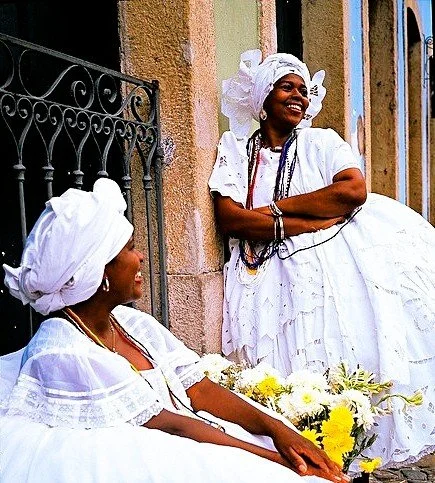
Baianas in Salvador, Bahia, Brazil.
A world of contrasts, unmistakably exotic.
Locals claim the city has 365 churches, one for each day of the year. In reality, there are perhaps 160, yet it feels like more: at every corner rises another baroque façade. In Pelourinho, the oldest quarter, the paint flakes and the cobbles are worn, but to wander there is to step into a forgotten century. Narrow streets, steep and gritty, wind past houses leaning with age. At the end of one alley stands the Carmelite monastery.
Inside lies an unexpected marvel: a cedar cross, crafted by a slave, its surface painted with banana-stem extract mixed with cow’s blood. The nuns paid him two thousand imported rubies — enough to buy his freedom. Instead, he pressed the jewels into Christ’s wounds.

The old district Pelourinho in Salvador, Bahia, Brazil.
Brazilians sing and dance with an ease that seems to defy hardship. Alongside Catholicism, they honour candomblé, brought from Africa. In Rio, people told me that on New Year’s Eve, the cariocas flock to Copacabana to light candles and set tiny offerings afloat upon the sea in tribute to the ocean goddess.
In Salvador, however, night carries danger. One evening, my friend and I ventured by taxi to Solar do Unhão, a former salt warehouse transformed into a restaurant where capoeira is performed. A dark stone lane guided us to a small square and a tiny church, faintly lit and eerily still. Inside the restaurant, a Baiana greeted us, and a maître d’ escorted us through stone chambers to a table overlooking the rocks below.

Solar do Unhao in Salvador, Bahia, Brazil.
When we stepped back into the square, a man emerged from the shadows, claiming to be a taxi driver. He quoted a price — and at that very moment the lights went out, plunging the square into complete darkness.
A loud sound echoed, and suddenly the small church was illuminated in a vivid purple glow. I nearly collapsed from fright. Matters improved somewhat when the taxi driver explained that the church was of historical importance and that a poetry recital accompanied by music would soon begin. That, at least, is what we believed he said, as he spoke Portuguese — which we did not understand.
With our lives seemingly at risk, we agreed to his price.
His taxi appeared — a battered two-door Volkswagen, from which escape would have been impossible. Yet it carried us safely back to our hotel, where we ended the night by the pool, surrounded once again by peaceful palms.

A scenic view along the coast in Salvador, Bahia, Brazil.
Good night, Salvador!
Wander the world through my writing,
Discover my Books in English Books in Italian Books in Greek
Related Articles
Bermuda: Atlantic Islands of Heritage and Grace
Beyond its Atlantic shores, Bermuda reveals charming pastel architecture, maritime heritage, pink-sand beaches and the serene elegance of island life.
Read the Story
Bahamas: Where the Sea Whispers of Adventure and the Past Still Lingers.
A journey through luminous waters and storied islands, where Columbus once arrived, Spanish galleons met their fate, pirates ruled Nassau, and Eleuthera was born from a quest for freedom.
Read the Story